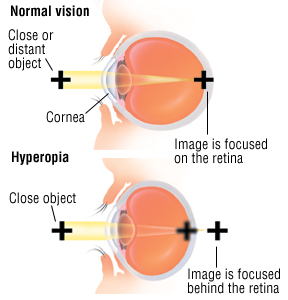
Symptoms, and Complications The interrelationship between structure and function in the visual system is the basis for many of the signs and symptoms experienced by patients with hyperopia Compound hyperopic astigmatism, especially when it is oblique or against the rule, causes correspondingly more visual problems than simple hyperopia of equal magnitude. As the levels of hyperopia and astigmatism increase, visual acuity decreases as a result of both optical blur and amblyopia.8 Young persons with hyperopia generally have sufficient accommodative reserve to maintain clear retinal images without producing asthenopia. However, both younger and older hyperopic patients, even those with mild hyperopia, may be symptomatic as a result of inadequate accommodative reserves for their levels of hyperopia. When the level of hyperopia is too great or the accommodative reserves are insufficient, due to age or fatigue, blurred vision and asthenopia develop. Presbyopia brings an increase in absolute hyperopia, causing blur, especially at near. The influence of accommodation on the vergence system also plays a role in the presence or absence of symptoms in patients with hyperopia. Individuals with esophoria and inadequate negative fusional vergence ability are frequently symptomatic because of the uncorrected hyperopia. Among the signs and symptoms of hyperopia are red or tearing eyes, squinting and facial contortions while reading, ocular fatigue or asthenopia, frequent blinking, constant or intermittent blurred vision, focusing problems, decreased binocularity and eye-hand coordination, and difficulty with or aversion to reading. The presence and severity of these symptoms varies widely. Some young patients with hyperopia, including those with moderate and high hyperopia, may be relatively free of signs and symptoms in Native Americans, African There is no known gender difference in the prevalence of hyperopia. Family history increases risk of hyperopia
1- Hyperopia is associated with maternal smoking during pregnancy, prematurity, and low birth weight.
2- Hyperopia is associated with lower literacy standards in children.
3- In our study reported that intelligence quotient scores are lower in hyperopic patients than in myopic patients.
4- Living in a rural area rather than an urban area is associated with a higher prevalence of hyperopia. 5- Hyperopia may also be associated with diabetes.