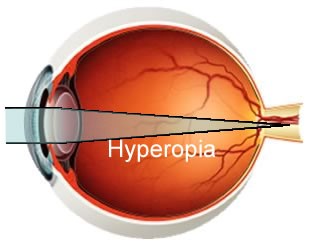
Hyperopia, also termed hypermetropia or farsightedness, is a common refractive error in children and adults. Its effect varies greatly, depending upon the magnitude of hyperopia, the age of the individual, the status of the accommodative and convergence system, and the demands placed on the visual system. Individuals with uncorrected hyperopia may experience:
• Blurred vision
• Asthenopia
• Accommodative dysfunction
• Binocular dysfunction
• Amblyopia
• Strabismus.
Early detection of hyperopia may help to prevent the complications of strabismus and amblyopia in young children. In older children, uncorrected hyperopia may affect learning ability.1 In individuals of any age, it can contribute to ocular discomfort and visual inefficiency.
A. Description and Classification of Hyperopia Refractive error is a manifestation of the relationship between the optical components of the eye (i.e., curvatures, refractive indices, and distances between the cornea, aqueous, crystalline lens, and vitreous) and the overall axial length of the eye. Hyperopia is a refractive error in which parallel rays of light entering the eye reach a focal point behind the plane of the retina, while accommodation is maintained in a state of relaxation.2 The magnitude of hyperopia is described as the additional dioptric power of the converging lenses required to advance the focusing of light rays onto the retinal plane, while accommodation is relaxed.
These correcting lenses may be spherical or spherocylindrical, depending upon the nature of the hyperopia and the amount of astigmatic refractive error co-existing with the hyperopia. Refractive errors, including hyperopia, may be differentiated by the degree of variance from a model of the optical components of the eye